Selecting the right storage and display fixtures dictates the operational efficiency of your supermarket or retail store. You need equipment built to last, designed to maximize your floor plan, and flexible enough to adapt to changing inventory.
This guide directly examines the core components that determine fixture quality and utility, focusing entirely on the types of steel used in commercial shelving manufacturing, the specific metrics for gondola shelving dimensions and weight capacities, and the necessary accessories and attachments for gondola shelving systems to optimize your space.
✔Key Takeaways
The durability of your supermarket fixtures relies heavily on the types of steel used in commercial shelving manufacturing, with cold-rolled steel acting as the industry standard.
Understanding exact gondola shelving dimensions and weight capacities prevents structural failure and ensures compliance with aisle safety protocols.
Standardizing your gondola shelving dimensions allows for seamless integration of modular display components across different retail departments.
Implementing the right accessories and attachments for gondola shelving systems increases product visibility and maximizes vertical merchandising space.
Partnering directly with a specialized supermarket shelving factory like Spieth ensures access to high-grade materials and exact specification matching.
Types of Steel Used in Commercial Shelving Manufacturing
When evaluating fixtures for your facility, the base material is the most critical factor. The types of steel used in commercial shelving manufacturing dictate the longevity, load-bearing capability, and visual finish of the final product. Choosing the correct gauge and processing method ensures your investment withstands high-traffic supermarket environments and heavy inventory loads.
Cold-Rolled Steel for Structural Integrity
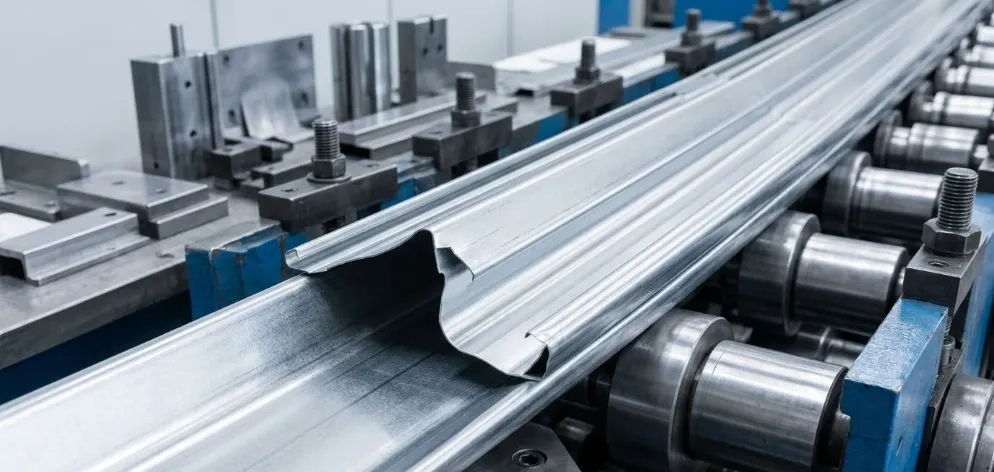
The majority of premium retail fixtures rely on cold-rolled steel. The cold-rolling process occurs at room temperature, which compresses the metal to yield a tighter molecular structure. This results in a material that is significantly stronger than hot-rolled alternatives. For your supermarket, this translates to thinner, lighter shelf profiles that do not sacrifice load-bearing capabilities. Cold-rolled steel also provides a remarkably smooth surface finish. This is essential for accepting the high-quality powder-coated paints required in commercial shelving manufacturing to prevent scratching from shopping carts and resist rust over time.
Galvanized Steel for Corrosive Environments
If your facility involves outdoor display areas, garden centers, or cold-room warehousing for perishable goods, standard powder-coated steel will eventually degrade. In these scenarios, galvanized steel is the required standard in commercial shelving manufacturing. By treating the metal with a protective zinc coating, it becomes highly resistant to oxidation and moisture. While it lacks the refined, glossy finish of indoor retail shelving, its utility in harsh, high-humidity environments makes it indispensable for specialized supermarket zones.
High-Tensile Structural Steel for Heavy Loads
For warehouse-retail hybrids or bulk merchandise displays, high-tensile structural steel is utilized for uprights and base brackets. This steel variant is alloyed to endure massive stress without yielding. When assessing the types of steel used in commercial shelving manufacturing, high-tensile steel guarantees that the central load-bearing columns of your aisles will not buckle under the pressure of dense, heavy inventory like bulk beverages, canned goods, or large pet food bags.
Steel Specifications Comparison
| Steel Type | Primary Supermarket Application | Key Benefit for Your Facility | Surface Finish |
|---|---|---|---|
| Cold-Rolled Steel | Standard shelves, back panels, brackets | High strength-to-weight ratio, perfect for retail aisles | Ultra-smooth, accepts powder coating |
| Galvanized Steel | Produce prep areas, cold storage, outdoor racks | Superior rust and moisture resistance | Industrial, spangled appearance |
| High-Tensile Steel | Upright columns, heavy-duty base shoes | Prevents buckling under massive weight stress | Smooth, usually powder-coated |
If you are also outfitting a backroom storage facility to support your retail floor, understanding base materials is just the first step. You may want to review our guidelines on heavy-duty warehouse racking configurations to match your back-end storage with your front-end sales volume.
Gondola Shelving Dimensions and Weight Capacities
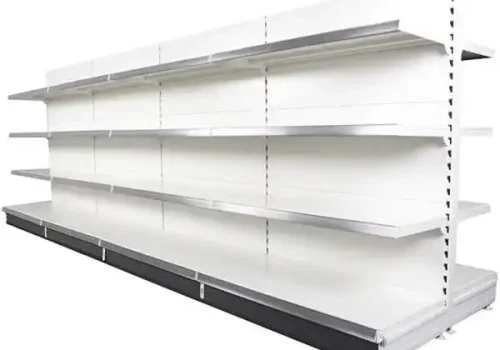
Precision is mandatory when planning your aisles. You must accurately map out your gondola shelving dimensions and weight capacities to maintain ADA-compliant aisle widths and ensure structural safety. Miscalculating these metrics leads to wasted square footage, cramped customer navigation, or fixture collapse.
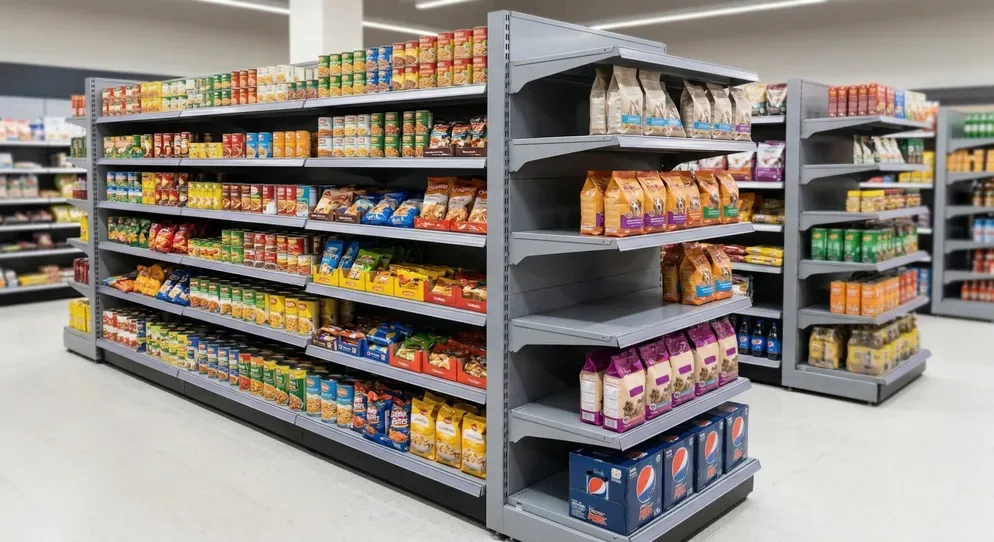
Standardized Widths and Depths
To guarantee modularity, gondola shelving dimensions and weight capacities operate on industry-standard increments.
- Widths: The standard section widths are 36 inches and 48 inches. You calculate your total aisle length by linking these modular sections together.
- Depths: Base shelf depths typically range from 16 inches for health and beauty items, up to 30 inches for bulk grocery items. Upper shelves are generally sized 2 to 4 inches shallower than the base shelf. This cascading design allows ambient lighting to reach the lower merchandise and provides customers with a clear line of sight to all products.
Understanding these exact gondola shelving dimensions and weight capacities allows you to accurately forecast how much inventory you can place on the floor versus what must remain in the stockroom.
Height Variations for Optimal Merchandising
The height of your uprights controls the traffic flow and visibility within your supermarket.
- Center Aisles: Standard double-sided gondolas (island shelving) usually utilize uprights ranging from 48 inches to 60 inches. This height allows your staff to easily restock and helps security cameras maintain an unobstructed view across the store layout.
- Perimeter Wall Aisles: Single-sided wall units utilize much taller uprights, typically ranging from 72 inches to 96 inches. These units maximize vertical space for expansive inventory lines, drawing the customer’s eye upward without blocking central sightlines.
Calculating Safe Weight Load Limits
Gondola shelving dimensions and weight capacities are directly linked to the shelf depth and the gauge of the steel bracket. A standard 48-inch wide, 16-inch deep shelf manufactured from cold-rolled steel can typically support up to 500 pounds of evenly distributed weight. However, as the depth of the shelf increases, the weight capacity slightly decreases due to the leveraged pull on the upright slot.
It is crucial to follow the principle of uniform weight distribution. Placing 400 pounds in the direct center of a shelf will cause deflection (bowing), whereas distributing that same 400 pounds evenly across the 48-inch span maintains structural integrity. Always ensure your heavier items (like water cases or laundry detergent) are placed on the base shelf, utilizing the floor to absorb the mass, keeping your gondola shelving dimensions and weight capacities well within safety margins.
Dimension and Capacity Matrix
| Component | Standard Dimensions | Max Weight Capacity (Evenly Distributed) | Best Supermarket Application |
|---|---|---|---|
| Base Shelf | 36″, 48″ W x 16″-30″ D | 600 lbs | Heavy bulk items, large liquids, appliances |
| Upper Shelf (Shallow) | 36″, 48″ W x 10″-14″ D | 400 lbs | Cosmetics, small electronics, packaged goods |
| Upper Shelf (Deep) | 36″, 48″ W x 16″-24″ D | 500 lbs | Hardware, large boxed goods, pet supplies |
| Wall Upright | 72″ – 96″ H | N/A (Dictated by base/shelves) | Perimeter walls, high-density vertical display |
Once your fixture sizes are locked in, optimizing the flow of foot traffic around them is your next priority. You can learn more about strategic placement by exploring our resources on supermarket floor plan optimization strategies to increase customer dwell time.
Accessories and Attachments for Gondola Shelving Systems
The steel frame provides the skeleton, but the accessories and attachments for gondola shelving systems provide the functional merchandising muscle. Standard flat shelves are not sufficient for every product category. To display hanging merchandise, separate small items, and clearly communicate pricing, you need to integrate specialized hardware.
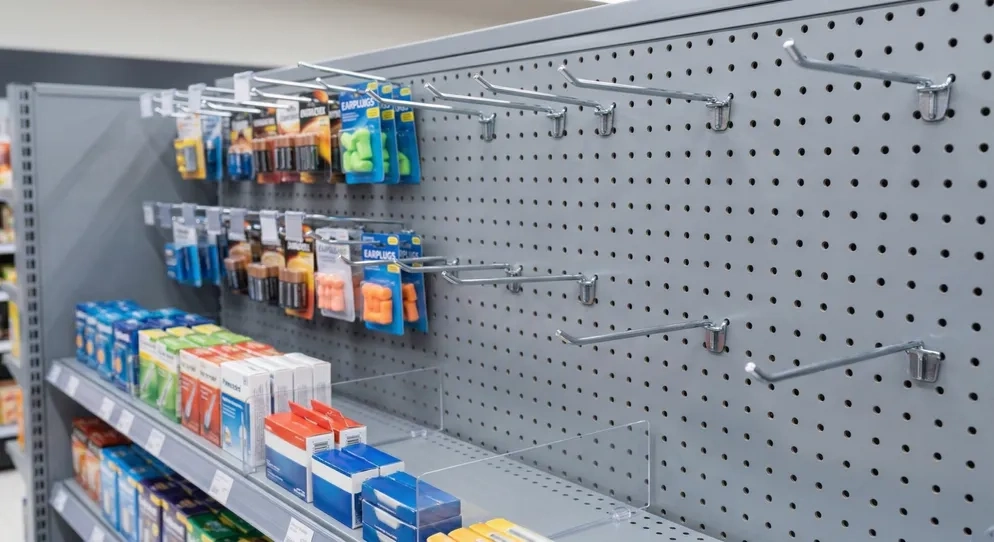
Maximizing Vertical Space with Pegboards and Slatwalls
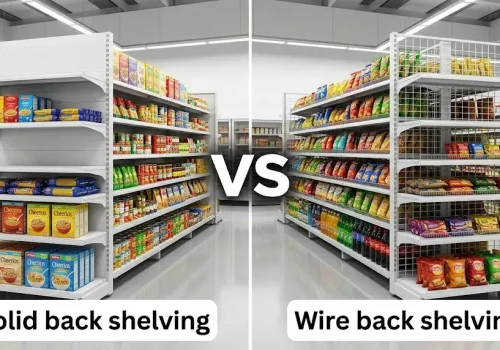
The back panels of your fixtures offer prime merchandising real estate. By utilizing pegboard or slatwall backing, you can integrate specific accessories and attachments for gondola shelving systems like peg hooks, waterfall hooks, and scanner hooks. This is strictly required for blister-packed items, batteries, and small impulse buys. Pegboards offer a cost-effective, versatile grid, while slatwalls provide a more premium, seamless aesthetic suitable for high-end retail sectors within your store.
Containment with Wire Baskets and Front Fences
Loose, oddly shaped, or highly mobile items (like fresh produce, seasonal clearance items, or baked goods) cannot sit neatly on flat steel. Implementing wire baskets as part of your accessories and attachments for gondola shelving systems solves this issue. Baskets replace the flat shelf entirely, allowing for deep, bin-style storage. Alternatively, if you want to retain the flat shelf but prevent items from rolling off the front edge, installing wire front fences and side guards creates a secure perimeter.
Shelf Dividers and Data Strips for Organization
Maintaining planogram integrity requires strict organization. Acrylic or wire shelf dividers act as rigid barriers, keeping different product SKUs clearly separated on the same shelf. This reduces restocking time and prevents visual clutter. Furthermore, pricing transparency is managed through data strips (ticket moldings). These plastic extrusions clip directly onto the front lip of the steel shelf, securely holding pricing labels, barcode tickets, and promotional call-out cards.
Selecting the exact accessories and attachments for gondola shelving systems tailored to your merchandise category is what transforms a simple metal rack into a high-performing retail machine.
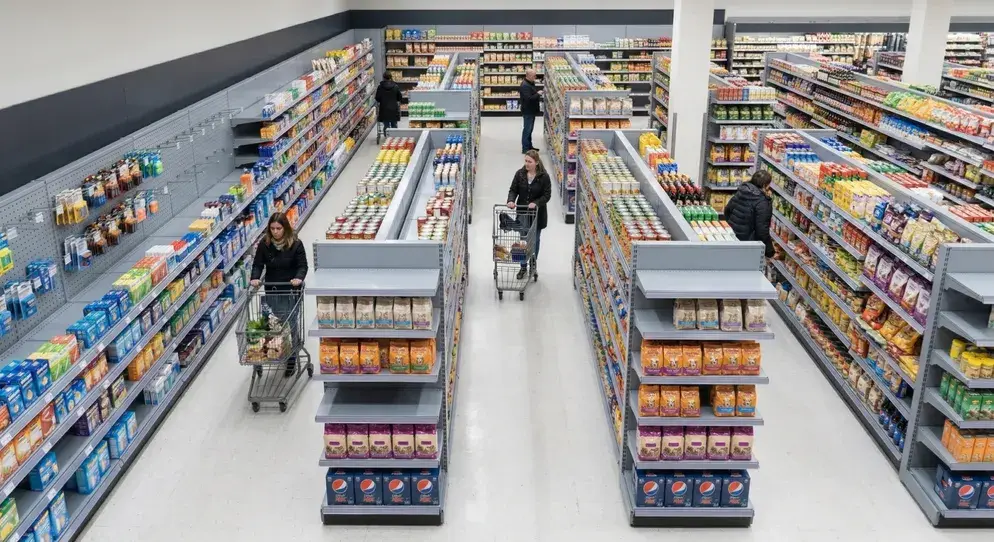
Essential Accessories Breakdown
| Accessory Category | Specific Attachment | Functionality |
|---|---|---|
| Hanging Hardware | Scanner Hooks, Peg Hooks | Displays blister-packs, allows for immediate pricing visibility |
| Containment | Wire Baskets, Front Fences | Holds loose merchandise, prevents product spillage |
| Organization | Acrylic Dividers, Pushers | Separates SKUs, automatically faces products to the aisle front |
| Signage | Ticket Molding, Header Signs | Secures barcodes, highlights promotions and brand categories |
Conclusion
Procuring the correct fixtures requires a strict understanding of the engineering behind the product. By prioritizing high-grade types of steel used in commercial shelving manufacturing, you guarantee the longevity of your investment. Adhering to precise gondola shelving dimensions and weight capacities ensures your floor plan is both safe and spatially efficient. Finally, outfitting your units with purpose-built accessories and attachments for gondola shelving systems maximizes your merchandising flexibility.
As Spieth, a dedicated supermarket shelving factory, we engineer our systems to meet exacting industry tolerances. We control the raw steel processing, the precise roll-forming of uprights, and the automated powder-coating lines to deliver fixtures that support your daily operational demands. Contact our engineering team today to submit your floor plan, request a detailed manufacturing quote, and receive direct factory pricing to elevate your retail space.
Frequently Asked Questions (FAQ)
What are the standard dimensions for gondola shelving?
Standard gondola shelving features section widths of 36 or 48 inches. Base depths range from 16 to 30 inches. Center-aisle units are typically 48 to 60 inches tall, while wall units range from 72 to 96 inches.
How much weight can a gondola shelf hold?
A standard commercial gondola shelf made of cold-rolled steel supports between 400 to 600 pounds of evenly distributed weight. Capacity varies based on the shelf’s depth and the steel bracket gauge.
What kind of steel is used for commercial shelving?
Cold-rolled steel is the primary material used in commercial shelving manufacturing for its high strength and smooth finish. Galvanized steel is used for damp environments, and high-tensile steel is used for heavy-duty structural uprights.
What accessories do I need for gondola shelving?
Essential accessories and attachments for gondola shelving systems include peg hooks for hanging goods, wire baskets for loose items, acrylic shelf dividers for SKU organization, and data strips for displaying pricing.