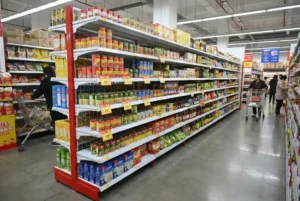
Starting a grocery store supermarket is hard; but choosing the right supermarket shelving for your grocery store shouldn’t be that hard.
Over the past 10+ years of exporting products to the U.S. and European markets, I’ve witnessed far too many store owners facing issues like shelves sagging or joints rusting just six months after opening. In this guide, I’ll not only list the different types of shelving, but also explain how to choose heavy-duty, high-load shelving, helping you cut maintenance costs by 20% and maximize the operational efficiency of your retail store.
If you’re looking for a supermarket shelving supplier, then our Spieth supermarket shelving is your best choice.
Key Takeaways:
- Materials: Why Q235 steel has a 5-year longer lifespan than ordinary iron.
- Load Capacity: The difference between static and dynamic loads.
- Back Plate Selection: How to choose between flat, perforated, and mesh backplates.
- Layout: How to increase sales by 15% using the “line-of-sight” principle.
- Logistics: How we optimize packaging to save you 30% on shipping costs.
1. Types of supermarket shelves:
Most product catalogs only list names. However, we will consider your actual application scenario and recommend a suitable supermarket shelf for you. Choosing the wrong type of supermarket shelf is the primary cause of wasted space when you have inventory.
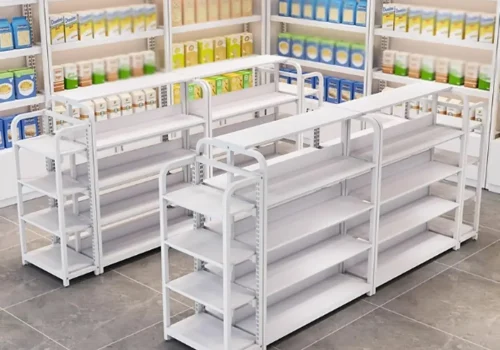
Gondola Shelving
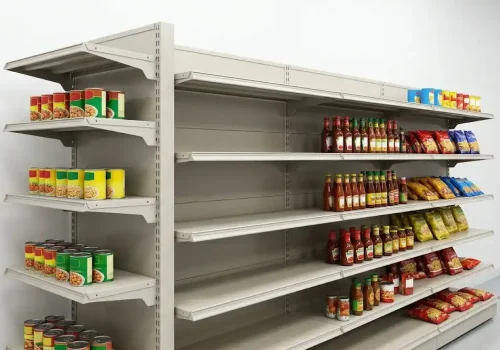
This is a staple in any grocery store, but if you are new to the industry, you might wonder what is gondola shelving and why it’s the gold standard for retail.
- Material Difference: We refuse to use Q195 steel, a common lower-priced alternative. Instead, we use Q235 cold-rolled steel in our production. Why Q235? Because it has 25% higher tensile strength. This means that even when the shelves are full of heavy canned food or beverage packaging, there will be no sagging in the middle.
- Technical Specifications: Our gondola racks can withstand a uniformly distributed load (UDL) of up to 150 kg per shelf.
- Applications: Ideal for central aisle storage of dry goods, grains, and heavy detergents.
End Cap Displays
These endcap display racks are located at the end of the shelving aisles. In retail, this is the best way to showcase your promotional merchandise.
Our research has shown that using our endcap display racks can increase impulse purchases by 30%.
Don’t just use standard gondola racks. We recommend customizing your racks with sturdy hooks or metal baskets to display high-margin items, such as promotional snacks or seasonal batteries, which will yield excellent sales results.
Fruit and Vegetable Shelves
The humidity level in fresh produce sections is very high, making ordinary steel shelves prone to rusting.
For these specific product models, we use a special anti-rust coating. Before mass production, our samples undergo a rigorous 300-hour salt spray test.
This ensures that our fruit and vegetable shelves resist corrosion for over 5 years, even in humid environments, guaranteeing that your food safety standards are not compromised by rusted equipment.
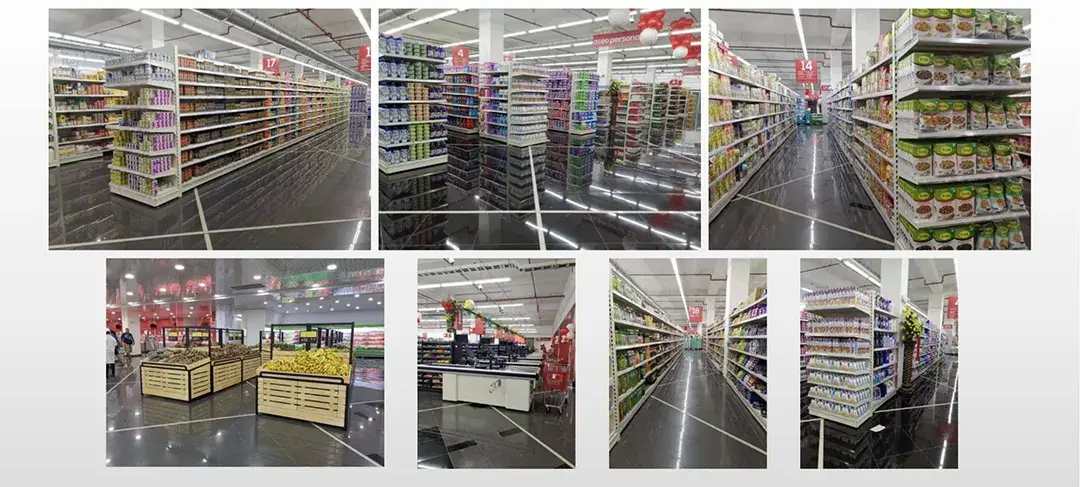
2.Q235B Cold-Rolled Steel vs. Q195 Steel
Not all steels are created equal. Many low-cost suppliers use Q195 steel to reduce costs by 15%. While this steel looks identical to regular steel, it lacks the tensile strength required for long-term retail use. You can refer to the comparison table below to see how to choose.
| Feature | Competitor (Q195 Steel) | Our Standard (Q235B Steel) | Why It Matters |
| Yield Strength | 195 MPa | 235 MPa | Higher resistance to permanent bending under heavy loads. |
| Carbon Content | Low (<0.12%) | Balanced (0.12%-0.20%) | Better hardness and structural rigidity. |
| Shelf Deflection | Visible after 6 months | < 1/200 of length | Your shelves stay flat, keeping displays looking professional. |
| Welding Quality | Prone to brittle joints | Superior fusion | Joints won’t crack even if the rack is dragged across the floor. |
Paying 5% less for Q195 steel now often results in paying 100% replacement costs in 2 years. We build our racks to last a decade.
While Q235B steel is our go-to for heavy-duty grocery needs, you can explore our full retail shelving materials comparison to see how steel stacks up against wire or wood options.
3. Technical Specifications of Supermarket Shelves
Load capacity:
You’ve likely searched for supermarket shelving suppliers in various places, and they’ll tell you their products have a “100kg load capacity.” However, they fail to specify whether this refers to static (stationary) load capacity or dynamic (during movement/impact) load capacity.
If you place a 100-kilogram bag of rice on a shelf designed only for static loads, and a customer violently collides with it using a shopping cart, the structural integrity of the shelf may be compromised.
All Spieth supermarket shelving units are tested with a 1.6 safety factor. This means that if our stated rated load is 100 kilograms, we have tested it to withstand 160 kilograms without permanent deformation.
Upright Column Thickness:
Many supermarket shelving suppliers deviate from market standards to cut costs, opting for 1.5mm thickness. Visually, there is no discernible difference between the two.
For heavier grocery items like cooking oil and bulk rice, we strictly recommend and use 2.0mm thickness.
This extra 0.5mm increases vertical load capacity by approximately 40%. This determines whether the shelf remains stable or sways when customers lean against it.
Surface Treatment:
You’ve probably seen paint peeling off shelves in large flakes—that’s caused by improper surface preparation.
We employ a five-stage automated spray coating line to ensure the coating adheres chemically, not just physically.
- Acid Washing (removes oil/dirt)
- Water Rinsing
- Phosphating (creates a bonding layer)
- Powder Coating
- High-Temperature Curing (200C)
Our finished coating thickness reaches 80μm, preventing paint chipping and scratches for at least 5 years even under daily high-intensity use. You can contact us to request a copy of our actual data.
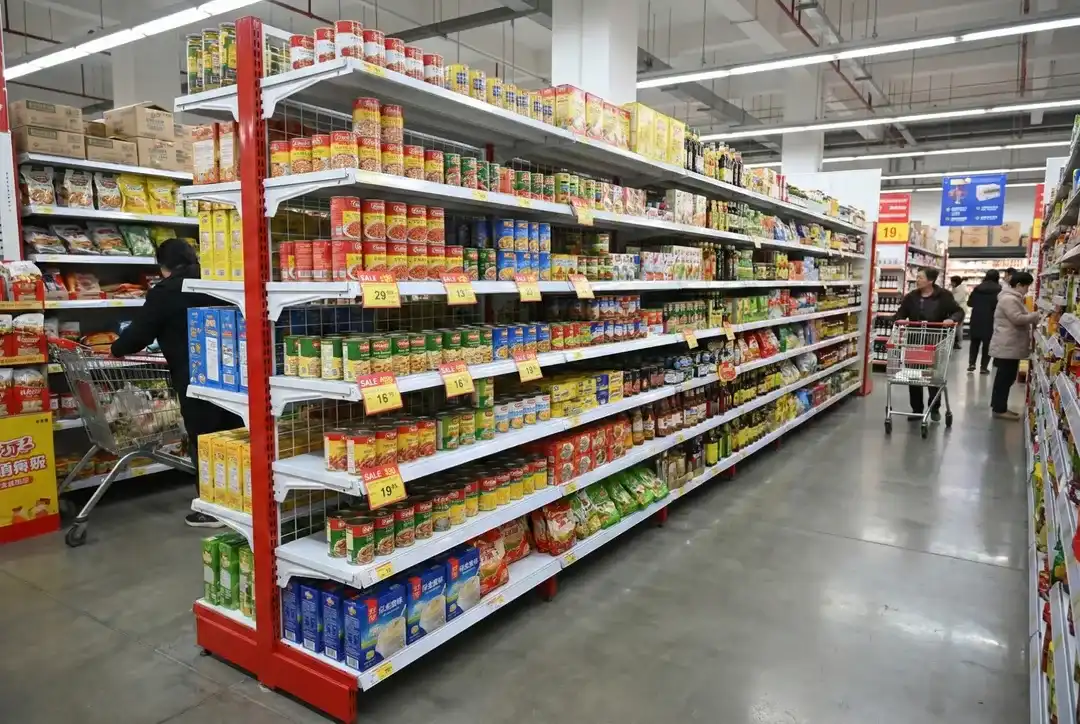
4. Choosing the Right Supermarket Shelves Back Panel
The back panel defines both the aesthetic and the functionality of your shelving. Don’t just pick what looks good—pick what works for your merchandise. We offer three distinct options:
1. Plain Back Panel
Standard back panels are typically suitable for use on standard grocery store shelves, such as those for rice, cooking oil, grains, and boxed foods.
- Pros: Clean look, easiest to clean, lowest cost.
- Factory Tip: We use a clip-on design rather than screws, speeding up installation by 30%.
2. Perforated / Pegboard Panel
Perforated/hanging boards are best suited for hardware, snack, candy, or hanging item areas.
- Pros: Allows the use of hooks to hang blister-pack products.
- Specs: Our standard hole distance is 25mm center-to-center, compatible with all universal hooks.
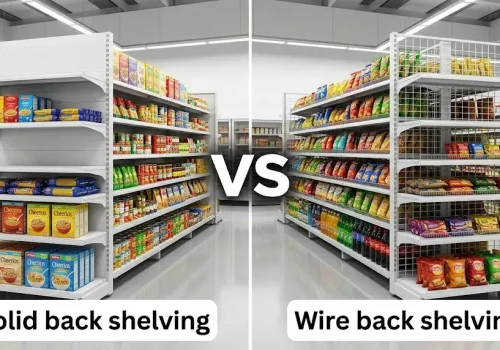
3. Wire Mesh Panel
Our wire back gondola shelving units are a popular choice for many of my customers. They are one of our hottest items and are best suited for small shops or aisles placed in front of shop windows.
- Pros: Translucent. It allows light to pass through, making small aisles feel wider and brighter.
- Cost: Cheaper than perforated panels but slightly more expensive than plain panels.
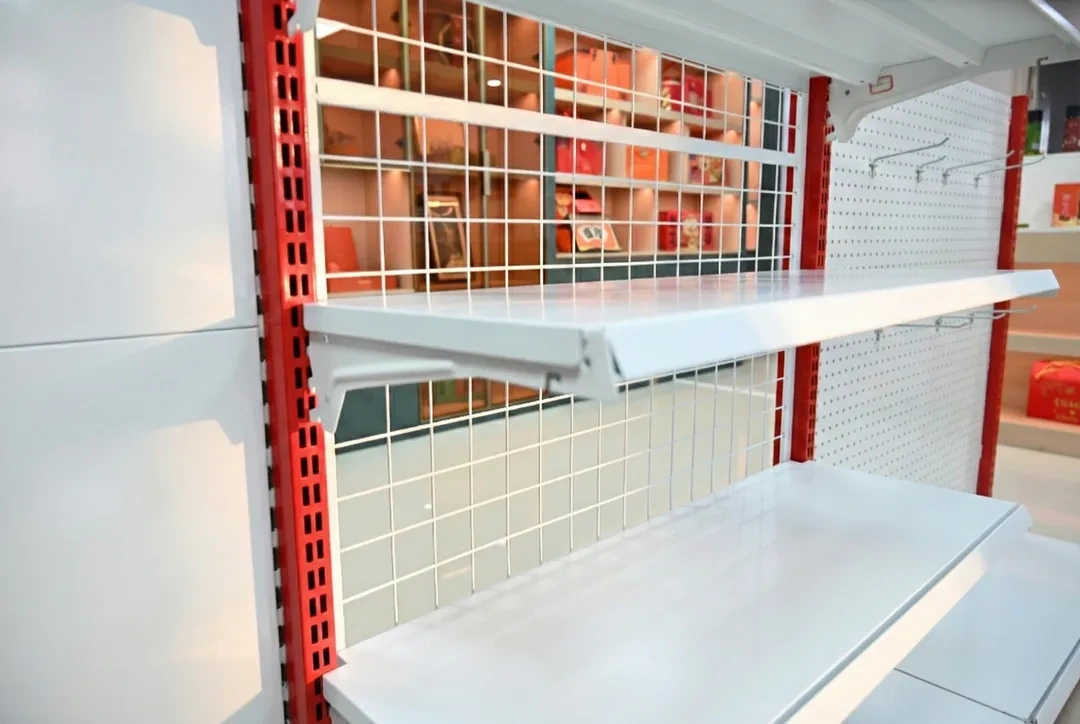
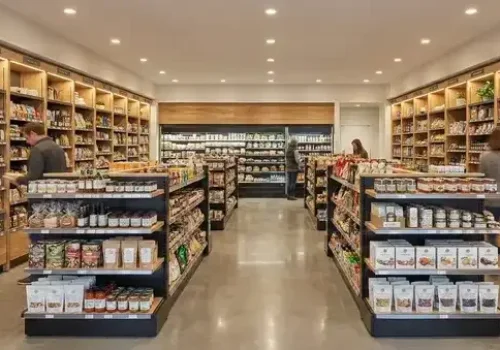
5. How to use supermarket shelves to layout a store
Buying the rack is step one; placing it correctly is step two. We don’t just ship metal; we help you plan your flow. Proper placement is a science, and our guide on how to plan your gondola shelving layout covers everything from traffic flow to decompression zones.
The “Eye-Level” Strategy
- Specific Advice: We recommend configuring your shelf heights so your high-margin products sit in the Golden Zone: 1.2m to 1.6m off the ground.
- Adjustability: Our shelves feature a tool-free adjustment system with 25mm increments, allowing you to micro-adjust heights to fit specific packaging perfectly.
Aisle Width
Don’t overcrowd your shop. It kills the customer experience.
- For Quick Marts: Minimum 900mm width. This allows one person with a hand basket to pass comfortably.
- For Supermarkets: We recommend 1200mm to 1500mm. For a full breakdown of standard heights, depths, and base sizes, refer to our gondola shelving dimensions guide. This allows two shopping trolleys to pass each other without jamming.
We had a case study with Kenter, a client in California who owned a mid-sized supermarket. His store was plagued by congested customer traffic. He contacted Spieth through rackleaders.com. After understanding his concerns, we redesigned his layout using modular shelving, widening the main aisle to 1200mm and maximizing vertical space by installing taller wall cabinets. We also added end-of-line shelving. The result? A 15% increase in customer traffic, with significant sales growth, especially on weekends.
6. Logistics & Packaging
Air freight is expensive. As an experienced supermarket exporter, Spieth has optimized our packaging to reduce your unit CIF cost.
- KD (Knock-Down) Design: Our racks are designed to be completely disassembled. A unit that stands 2 meters high packs down into flat cartons just 15cm thick.
- The “Air Test”: We utilize specialized software to calculate the container loading plan. We guarantee 95% container volume utilization, ensuring you don’t waste money on empty space.
- Damage Control:
- Bubble Wrap: Wraps every upright column to prevent scratches.
- 5-Layer Corrugated Cartons: Used for all shelves.
- Corner Protectors: Reinforced cardboard on all corners to withstand impact during forklift handling.
Our Promise: Our breakage rate during shipping is less than 0.5%, compared to the industry average of 3%.
7. Installation and Maintenance
Supermarket floors are rarely perfectly flat. Installing rigid shelves on uneven surfaces can cause them to wobble, creating a safety hazard.
The best solution is to install an adjustable base. Every column we manufacture comes with a sturdy and durable threaded adjustable base. This allows you to adjust the height of each leg by up to 30 mm.
If your floor corners sag slightly, simply unscrew the base screws to level the shelf immediately. No shims or wedges are needed.
Although our powder coating is durable, the product still requires regular maintenance. We recommend wiping the shelves monthly with a damp cloth (containing a small amount of mild detergent). To keep the high-gloss surface looking new for years to come, avoid using harsh cleaning tools.
Frequently Asked Questions
What is the best material for grocery shop racks?
How do I calculate the number of racks for my shop?
What is the MOQ for custom orders?
Are the racks difficult to assemble?
What if my floor is uneven?
9. Conclusion
Choosing the right supermarket shelves for your grocery store is not just about storage; it’s also about safety, efficiency, and long-term return on investment.
By choosing a supermarket shelving manufacturer that uses Q235 steel, 2.0 mm uprights, and certified powder coating, you’re not just spending money, you’re saving on future shelving replacement and maintenance costs.
Ready to optimize your store with factory-direct pricing? Contact us today. Send us your floor plan, and we’ll provide a free product catalog and customized 3D layout design within 24 hours.