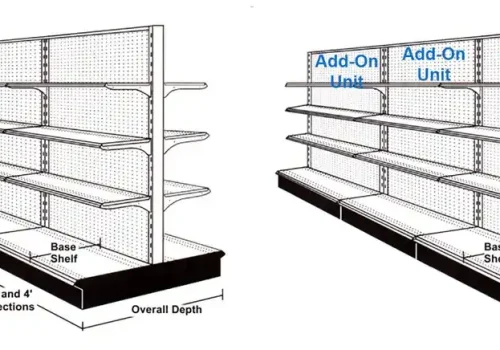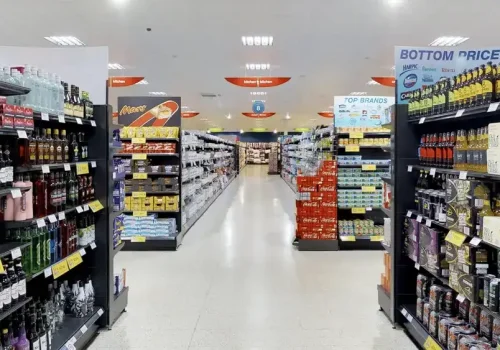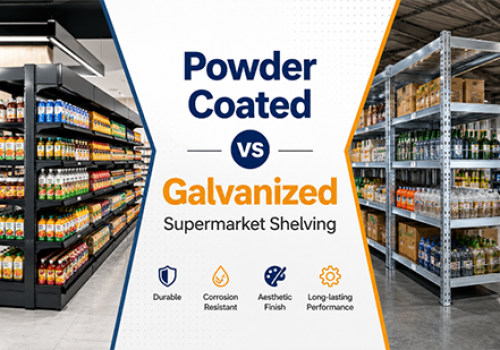
Gondola shelving is widely used in retail stores and supermarkets, where layout design plays a crucial role in both customer experience and sales performance. Aisle width is not just a structural detail—it directly affects how comfortably customers move through the store, how long they stay, and how easily they can access products. Therefore, store planning must balance two key goals: providing enough space for customers to walk and shop comfortably, while also maximizing shelving capacity to display as many products as possible within limited floor space.
What Is the Standard Aisle Width for Gondola Shelving?
When designing a retail floor plan, adherence to industry standards ensures that your store feels professional and functions seamlessly.
Across the entire retail sector, gondola shelving aisle widths typically range from 36 to 72 inches (0.9 to 1.8 meters).
For the vast majority of standard retail environments, the most common and effective aisle width is 42 to 48 inches (1.1 to 1.2 meters). This range strikes the ideal balance between spatial comfort and high inventory density.
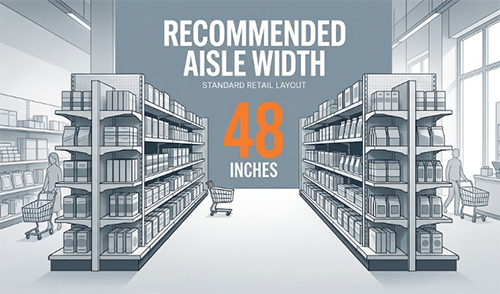
Recommended Aisle Width for Different Retail Environments
Different retail formats serve different customer behaviors. Matching your aisle width to your specific business model is essential for optimizing sales.
Small Convenience Stores
36–42 INCHES
The Strategy: In smaller footprints, space-saving is the absolute priority. Because customers usually buy fewer items and rarely use large shopping carts, aisles can be narrower to maximize the number of gondola shelves and products on display.
Supermarkets & Grocery Stores
42–48 INCHES
The Strategy: This is the industry baseline for balanced traffic and product display. It allows two customers with standard shopping carts to pass each other comfortably without hitting the shelves, ensuring a smooth, low-stress grocery shopping experience.
Big-Box Retail Stores
54–72 INCHES
The Strategy: Large-format stores (like department stores or home improvement centers) experience heavy customer flow and utilize oversized shopping carts or flatbeds. Wider aisles prevent gridlock and accommodate bulky merchandise.
Main Aisles & Promotional Areas
72+ INCHES
The Strategy: Also known as “race tracks” or “action alleys,” these are the heavy traffic zones that connect the store. They need to be wide enough to handle massive crowds and accommodate freestanding promotional displays without creating bottlenecks.
Key Factors That Affect Gondola Shelving Aisle Width
Before bolting your gondola shelving to the floor, consider these five critical variables:
How to Balance Aisle Space and Shelving Capacity
Retail design is a game of compromise. To maximize your profitability, you must skillfully manage the trade-off between walking space and product density.
⚠️ THE RETAIL DILEMMA
“If your aisles are too wide, you lose valuable square footage where products could be selling. If they are too narrow, the ‘butt-brush effect’ takes over—customers will leave an aisle if they are repeatedly bumped from behind.”
To maximize your SKU (Stock Keeping Unit) display without overcrowding, implement a hierarchical store zoning strategy. Use wider main aisles to draw customers deep into the store, and utilize narrower, high-density secondary aisles for destination items that customers actively seek out.
Common Mistakes in Aisle Width Planning
- ✕
Making Aisles Too Narrow: This creates a claustrophobic customer experience, lowers browse time, and can make your store inaccessible to strollers and wheelchairs. - ✕
Over-Widening Aisles: Leaving too much empty space results in a direct loss of selling space, making the store look empty and reducing your sales per square foot. - ✕
Ignoring Cart Movement Patterns: Forgetting to calculate how customers turn corners or pause to look at items leads to localized traffic jams. - ✕
Not Considering Peak-Hour Congestion: An aisle that feels spacious on a quiet Tuesday morning might become completely impassable during Saturday afternoon rushes.
Best Practice for Gondola Shelving Layout Design
To ensure your retail space is optimized for both comfort and conversions, follow these proven best practices:
Set a Baseline of 48 Inches: When in doubt, 48 inches is the safest and most effective starting point for standard retail gondola layout design.
Create a Hierarchy of Widths: Guide the customer journey by varying your widths—widest at the entrance and main corridors, standard in the product aisles.
Utilize Endcaps Strategically: Pair your aisle widths with well-designed endcaps (the displays at the end of gondola runs) to capture impulse buys at high-traffic intersections.
Plan for the Future: Choose modular gondola shelving that can be easily adjusted or reconfigured as your product lines expand or seasonal demands change.
Conclusion
Aisle width is a silent yet powerful factor in retail success.
It shapes how customers perceive your brand, how comfortably they shop, and ultimately, how much they buy. Proper planning goes far beyond mere aesthetics; it directly improves both the customer experience and your store’s operational efficiency. By carefully balancing customer comfort with shelving density, you can create a high-yielding retail environment that keeps shoppers coming back.