When planning a retail store layout or upgrading existing shelving systems, one of the most overlooked but important decisions is choosing between open back and solid back gondola shelving.
Although both systems share the same base structure and accessories compatibility, their performance in real retail environments can be very different.
Based on retail shelving projects supplied to supermarkets, pharmacies, convenience stores, and specialty retail chains, this guide explains the real-world differences from a procurement and store operation perspective—not just theoretical comparisons.
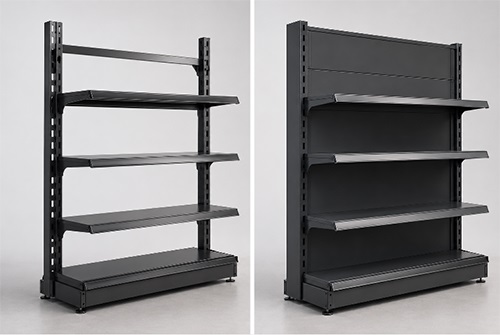
Quick Comparison Overview
| Feature | Open Back | Solid Back |
|---|---|---|
| Product Visibility | High | Moderate / Controlled |
| Store Aesthetic | Functional / Industrial | Clean / Premium |
| Material Cost | Lower | Higher |
| Installation Speed | Faster | Slightly Slower |
| Best Use Case | Supermarkets / High-turnover stores | Pharmacies / Premium retail |
Note: Actual performance may vary depending on shelf height, load capacity, and store layout design.
Structural Difference Between Open Back and Solid Back Systems
At first glance, the two systems look similar because they share the same uprights, base legs, and shelving tiers.
However, the key difference lies in the rear structural design, which directly affects stability, visual merchandising, and material usage.
Open Back Gondola Shelving
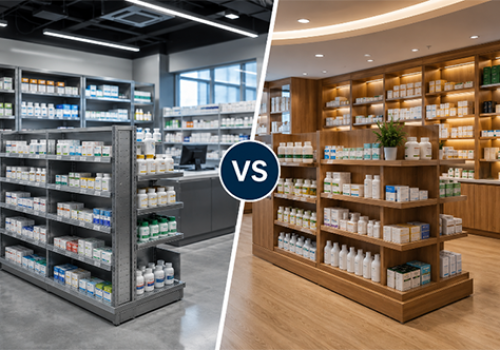
Open back systems eliminate full rear panels, leaving a structural frame that reduces material usage and weight.
This design improves product visibility from both sides and allows easier access during stocking and maintenance.
Solid Back Gondola Shelving
Solid back systems use metal or panel backing that fully encloses the rear structure.
This increases rigidity and creates a clean visual barrier, often preferred in high-end retail environments where branding and presentation matter.
In real installation projects, solid back systems typically require slightly more labor due to additional panel alignment and fastening steps.
Open back systems, by contrast, are faster to assemble and easier to reconfigure during store remodeling.
Open Back Gondola Shelving: Practical Advantages and Trade-offs
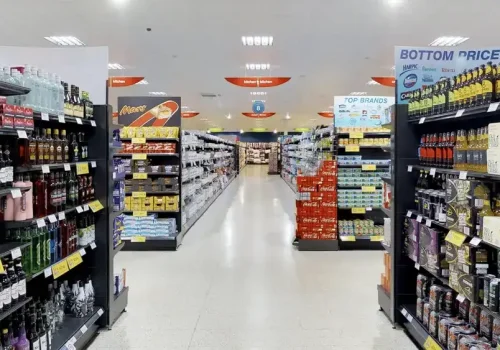
Open back gondola shelving is widely used in supermarkets, discount stores, and high-turnover retail environments.
Its design prioritizes accessibility and cost efficiency, making it one of the most common shelving systems in global retail chains.
1. Better Product Visibility and Customer Flow
One of the main advantages of open back shelving is improved visibility.
Customers can see products through and around shelving units, which helps reduce visual barriers inside the store.
In supermarket layouts, this often contributes to smoother traffic flow and better aisle perception.
2. Lower Material and Transportation Cost
Because open back systems use less steel and fewer panels, overall production cost is lower.
This also reduces shipping weight and container utilization cost, which is a key factor for importers and chain retailers optimizing total procurement budget.
3. Easier Reconfiguration and Maintenance
Retail environments frequently adjust shelf layouts based on seasonal promotions or product category changes.
Open back systems allow faster adjustments because there are fewer rear components to disassemble.
Limitations in Real Retail Use
Despite its advantages, open back shelving is not ideal for all store types.
In premium retail environments such as pharmacies or cosmetic stores, the exposed structure may reduce perceived store quality.
It also provides less visual separation between product categories, which can affect branding consistency in high-end retail design.
Solid Back Gondola Shelving: Why High-End Retail Stores Prefer It
Solid back gondola shelving is commonly used in pharmacies, cosmetic stores, boutique supermarkets, and branded retail environments.
Unlike open back systems, the rear structure is fully enclosed with metal panels, creating a cleaner and more controlled visual presentation.
In real retail projects, solid back systems are not chosen only for aesthetics.
They are often selected as part of a broader store branding and merchandising strategy, especially in environments where customer perception directly impacts purchasing behavior.
1. Stronger Visual Branding and Shelf Background Control
Solid back panels create a uniform visual background behind products, which helps highlight packaging design and branding elements.
In cosmetic and pharmacy retail environments, this reduces visual noise and improves perceived product value.
2. Improved Structural Rigidity
From an engineering perspective, solid back systems generally provide higher rigidity compared to open back systems.
The rear panels help distribute load stress across the frame, which can improve long-term stability in high-load retail environments.
3. Better Product Segmentation in Premium Stores
In stores where category clarity is important—such as cosmetics, skincare, or pharmaceuticals—solid back shelving helps visually separate product zones.
This reduces distraction between adjacent aisles and supports structured merchandising strategies.
Trade-offs to Consider
Solid back systems typically require higher material cost due to additional steel panels and finishing processes.
Installation time is also slightly longer, especially in large supermarket projects where hundreds of bays are installed.
For budget-sensitive retail chains, this can significantly affect total project cost.
Which Stores Should Choose Open Back vs Solid Back?
In actual retail fixture projects, the decision is rarely based on price alone.
Store type, product category, brand positioning, and replenishment frequency all influence the final selection.
Supermarkets and Grocery Stores
Open back shelving is more commonly used in supermarkets due to its cost efficiency and high product turnover.
The open structure improves visibility across aisles, helping customers navigate large store layouts more easily.
For chain supermarkets focusing on operational efficiency, this is usually the default choice.
Convenience Stores
Convenience stores often prefer open back systems due to limited floor space and frequent product replenishment.
The easier access to shelves allows staff to restock quickly without disrupting customer flow.
Pharmacies
Pharmacies typically lean toward solid back shelving because of branding requirements and product sensitivity.
A cleaner visual background helps highlight packaging clarity and creates a more controlled shopping environment.
Cosmetic and Skincare Stores
Cosmetic retail environments prioritize presentation over cost efficiency.
Solid back shelving supports premium branding, better lighting effects, and improved product focus, which directly impacts customer perception.
Boutique and Specialty Retail
Boutique stores often choose solid back systems to maintain consistent visual identity across the store.
This is especially important in curated retail environments where every shelf contributes to brand storytelling.
Practical Procurement Logic Used in Real Projects
In real-world procurement, buyers usually evaluate gondola shelving using a combination of budget, store positioning, and operational needs rather than technical specifications alone.
If the priority is cost efficiency and fast rollout: open back shelving is typically selected.
If the priority is store branding and visual presentation: solid back shelving becomes the preferred option.
If the store is a hybrid format (mid-range supermarket): many projects use a mixed approach, combining open back in central aisles and solid back along perimeter walls.
This hybrid configuration is becoming increasingly common in chain retail projects, especially in markets where stores are designed as both shopping and brand experience environments.
Cost Comparison: Why Total Project Cost Matters More Than Unit Price
When comparing open back and solid back gondola shelving, many buyers initially focus only on unit price differences.
However, in real retail fixture projects, the total cost structure includes far more than just the shelf itself.
Based on supermarket and convenience store projects supplied across different regions, the final procurement decision is usually influenced by five cost layers:
• Material cost (steel usage, panels, finishing)
• Shipping cost (weight and volume efficiency)
• Installation labor cost (assembly time per bay)
• Maintenance cost (long-term adjustment and repair)
• Lifecycle replacement cost (durability over time)
Open back shelving generally reduces material and shipping costs due to reduced steel usage.
Solid back shelving increases upfront cost but often provides stronger long-term visual stability and branding consistency.
Engineering Perspective: Load Capacity and Structural Behavior
From a structural engineering standpoint, both open back and solid back gondola shelving systems can achieve similar load capacities when properly designed.
The difference lies in how structural stability is distributed across the frame.
Open Back Systems
Open back shelving relies primarily on upright frames and shelf brackets for load distribution.
This makes it lighter and easier to assemble, but requires precise installation to ensure stability, especially in tall shelving configurations.
Solid Back Systems
Solid back shelving adds rear panels that improve lateral rigidity.
In practical installations, this helps reduce slight frame movement under uneven loading conditions, especially in high-traffic retail environments.
In most supermarket projects, load capacity differences are not determined by back type alone,
but by shelf thickness, upright gauge, and beam reinforcement design.
Shipping and Installation Differences in Real Projects
Logistics and installation efficiency often have a direct impact on project timelines, especially for chain store rollouts.
Shipping Efficiency
Open back shelving typically allows higher container utilization due to reduced panel volume.
In 40HQ container shipments, this can translate into improved loading efficiency and reduced per-unit freight cost.
Installation Time
Open back systems are generally faster to install because they involve fewer rear components and alignment steps.
Solid back systems require additional panel fixing and alignment, which can increase installation time in large-scale supermarket projects.
In chain retail rollouts, even small differences in installation speed can significantly affect overall project scheduling and labor cost.
Frequently Asked Questions
Yes. When designed with the same upright thickness and beam structure, both systems can achieve similar load capacity.
The back structure mainly affects rigidity and visual stability, not primary load rating.
Yes, this is a common practice in modern retail design.
Many supermarkets use open back shelving in central aisles and solid back systems along perimeter walls for better visual impact.
Generally yes, due to additional steel panels and finishing processes.
However, total project cost differences depend on store size, layout complexity, and installation requirements.
Open back shelving is often preferred for large-scale rollouts due to lower cost and faster installation.
However, solid back systems are frequently used in flagship stores within the same chain to enhance brand positioning.
Final Decision Logic Used in Real Retail Projects
In actual retail shelving procurement projects, the decision between open back and solid back gondola shelving is rarely based on a single factor.
Instead, buyers usually evaluate store positioning, operational efficiency, and long-term branding strategy together.
Open Back Gondola Shelving is typically selected when:
• Budget efficiency is a priority
• Fast installation is required for chain store rollout
• High product turnover requires easy stocking access
Solid Back Gondola Shelving is typically selected when:
• Store branding and visual presentation are critical
• Premium retail environments require cleaner shelf backgrounds
• Product segmentation and display control are important
Hybrid layouts are increasingly common:
Many modern supermarkets use open back shelving in central aisles and solid back shelving along perimeter walls to balance cost and visual impact.
Professional Recommendation from Retail Fixture Experience
Based on multiple supermarket, pharmacy, and convenience store projects, there is no universal “better” option between open back and solid back gondola shelving.
The right choice depends on how the store balances cost structure, merchandising strategy, and customer experience.
In cost-sensitive large-scale supermarket projects, open back shelving remains the most widely used solution due to its efficiency and flexibility.
In contrast, solid back shelving is more commonly applied in premium retail environments where brand presentation plays a stronger role in purchasing behavior.
Conclusion
Choosing between open back and solid back gondola shelving is ultimately a strategic decision that affects not only cost,
but also store efficiency, customer experience, and long-term brand positioning.
For most retail environments, the most effective solution is not choosing one over the other, but designing a system that balances both based on store layout and commercial goals.